Showing posts with label J.-P. Rameau. Show all posts

10-12: Blue Cheer Japan 1999 - Sex Pistols Indecent Exposure 6 CDs - Franco & TP OK Jazz : 1972/1973/1974 - B-52's Dortmund 1983 - Rameau Zoroastre : Kuijken 1983 - Hollywood SQ : Schoenberg Verklärte Nacht | Schubert Quintet


1692 – Giovanni Battista Vitali (Italian composer, violone player & church music director)
1794 – James Lyon (American composer & sacred tunebook compiler)
1797 – Pierre de Jélyotte (French operatic haute-contre, harpsichordist, guitarist, violinist & composer, created roles in several Rameau operas)
1817 – Johann Franz Xaver Sterkel (German composer, pianist & priest)
1865 – William Vincent Wallace (Irish composer, violinist, pianist & adventurer, active in Australia & the Americas)
1924 – Monroe Althouse (American military band composer, violinist, cornetist & trombonist)

1956 – Don Lorenzo Perosi (Italian monsignor, composer, organist, pianist & teacher)
1966 – Arthur Lourié [Артур Лурье] (Russian composer & painter, active in France & the U.S., friend of Stravinsky)

1971 – Gene Vincent (American rock singer & guitarist)
1974 – Joseph Frederick Wagner (American composer, conductor, teacher & author)
1978 – Nancy Spungen (American rock groupie, girlfriend of Sid Vicious)
1982 – Chris Reumer (Dutch operatic tenor)
1985 – Ricky Wilson (American New Wave guitarist, bass guitarist, keyboardist, singer & songwriter, The B-52's)

1989 Franco [François Luambo Makiadi] (Congolese rumba singer, songwriter & guitarist)
1995 – Eleanor Aller (American cellist, Hollywood String Quartet, mother of Leonard Slatkin)
1996 – Vernon Elliott (English bassoonist, conductor & composer)
1997 – John Denver (American folk, country & pop singer, songwriter, guitarist, activist & humanitarian)
2002 – Ray Conniff (American pop, rock & jazz bandleader, arranger, composer, trombonist & singer)
2009 – Dickie Peterson (American bass guitarist, singer, guitarist & songwriter, Blue Cheer)


More insanity, another big opera, it never ends. We had bel canto opera two days ago, Teutonic music drama yesterday, and today it's Baroque opéra tragique, courtesy of Monsieur Rameau. Pierre de Jélyotte (that's him - yes, him - just to the left of  Franz X. Sterkel; with his high tenor voice, many of Jélyotte's roles were female) sang in the premiéres of several Rameau operas, including Hippolyte et Aricie, Les Indes galantes, Dardanus, and Zoroastre. He created the title roles in many of them, including Zoroastre, who was... A MAN! Thus Sang Zarathustra.

Well, I could tell you a lot more about a lot of these folks, but you've got a lot of homework to do already down there ↓↓↓.  I guess before I sign off I should apologize for flipping that photo of Eleanor Aller backwards. It became sort of unavoidable for the sake of the continuity of the collage. You string players probably already noticed it, because one holds the bow with the right hand, not the left!

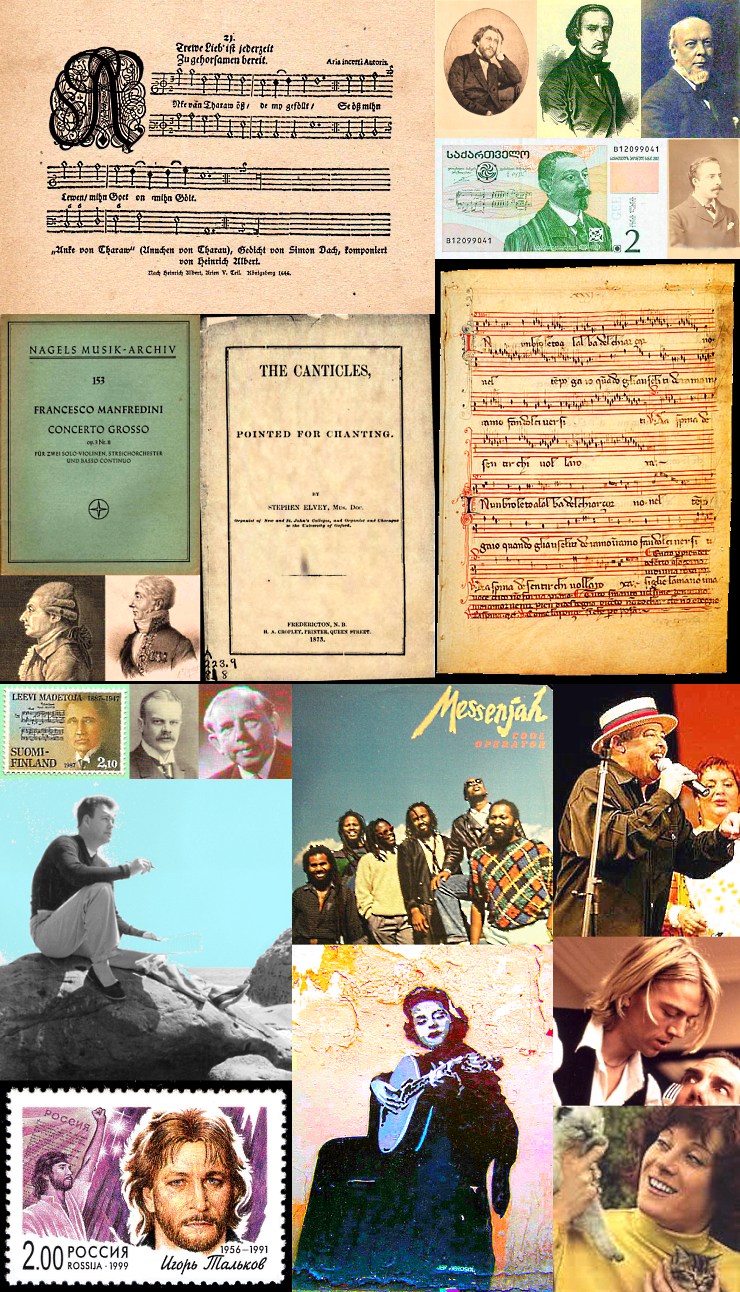
10-06: Amália Rodrigues Best of Fado - И́горь Талько́в Grand Collection - Rosemary Clooney Solves the Swingin' Riddle 1961 - Véronique Gens / Christophe Rousset : Tragédiennes 2


1651 – Heinrich Albert (German composer & poet)
1762 – Francesco Manfredini (Italian composer, violinist & church musician)
1786 – Antonio Sacchini (Italian opera composer)
1837 – Jean-François Le Sueur (French composer & conductor, teacher of Berlioz, Gounod & A. Thomas)
1860 – Stephen Elvey (English organist & composer)
1868 – Léon Kreutzer (French composer & pianist, nephew of Rodolphe)
1874 – Thomas Tellefsen (Norwegian pianist & composer)

1909 – Dudley Buck (American composer, organist, writer & teacher)
1933 – Zakaria Paliashvili [ზაქარია ფალიაშვილი
] (Georgian composer, conductor, hornist & folk song collector)
1935 – Sir Frederic Hymen Cowen (Jamaican-born English pianist, conductor & composer)
1940 – Ferdinando Liuzzi (Italian musicologist & composer, specialist in the Italian Trecento)
1947 – Leevi Madetoja (Finnish composer)
1954 – Hakon Børresen (Danish composer)

1973 – Arnold Walter (Czech-born Canadian musicologist, teacher, composer, pianist & writer)
1985 – Nelson Riddle (American arranger, composer, bandleader, orchestrator & trombonist)

1991 – Igor Talkov [И́горь Талько́в] (Russian rock singer, songwriter & guitarist )
1995 – Walter "Crash" Morgan (Canadian reggae & rock drummer, Messenjah, Big Sugar)
1999 – Amália Rodrigues (Portuguese fado singer, player of the Portuguese guitar & actress)

2004 – Marvin Santiago (Puerto Rican salsa singer & comedian)
2010 – Antonie Kamerling (Dutch actor & pop singer)

2010 – Colette Renard (French actress & pop singer)

They call Amália Rodrigues "Rainha do Fado" - the Queen of Fado, because it is she who did most to popularize this genre of music in the 20th century. And what is fado? It's a kind of Portuguese traditional music (one cannot call it "folk" music, because in some ways it is more a type of classical music) that originated almost 200 years ago, but has roots that go back much further. It is music with a solo singer, usually accompanied by the Portuguese guitar, an instrument very different from the usual guitar, with a rounded body and 12 strings, strung in double courses. There are two types of Portuguese guitar, as there are two types of fado - Lisboa and Coimbra, in both cases (I believe that's a Lisboa guitar Rodrigues is playing above).

As the guitars are shaped, tuned, and played in slightly different ways, likewise there are differences in the two types of fado. It is from Coimbra that fado gets its "academic" traditions, for Coimbra, in inland northwestern Portugal, has been a university town since the middle ages. Coimbra fado is usually performed only by men, who wear a particular kind of traditional black academic uniform, in a fairly formal setting. So, when you have a female singer of fado, like Amália Rodrigues, it's a pretty good bet you're listening to the Lisboa type! Also, in Coimbra fado, there is a peculiar way the audience has of expressing its approval - rather than applauding with the hands (which is what's done in Lisboa fado), they cough, or clear the throat. I'm all for this tradition being picked up by classical audiences, because it might cut down on all the coughing during the performances! And it is from Lisboa that fado gets its "marine" traditions, since Lisbon is of course on the coast, and has been an important port city since ancient times. The lyrics of fado traditionally deal with the life of the sea and sailors, and the life of the common poor people. But fado can have other kinds of lyrics, and it can also use many different kinds of instrumental accompaniment, such as a string quartet, or even a full orchestra.

Fado is a melancholy music. It is as hard to describe as it is to explain the Portuguese word with which it's most associated - saudade. Saudade is a word that can't be translated into any other language, at least not with a single word. It means the dreamlike feeling of longing one has for someone or something that has gone away, and left an emptiness that can't be filled by anyone or anything else. At the same time, it expresses the hope, often against all odds, that that for which one feels the saudades will return one day and make life whole again. Yet further, it expresses the fantasies about this fulfillment brought on by these hopeful feelings.

So you see, saudade is very hard to explain with the tongue, but very easy to understand with the heart. And it's the same with fado! So, let the beautiful music of Amália Rodrigues come into your ear and from there it will be transported to your heart, and you'll understand it all!

Be sure to follow the links in the list and read up on Nelson Riddle, one of the greatest arrangers in 20th-century music, who's most associated with the mid-career recordings of Frank Sinatra; and Igor Talkov, the Russian rock singer who took political risks in the Soviet era and became so beloved in his country; and Georgian composer Zakaria Paliashvili, who's considered to be the father of a truly national classical music in his home country.

Before I leave you, I'd like you to look at that page of 14th-century Italian black mensural notation that's on the right in the collage, and is in the spot where a photo of Ferdinando Liuzzi ought to be. Now, if you don't read music, that page might not be any more inscrutable than the page that's at the top left, from more than 300 years later, which is actually in modern notation, despite a few orthographic differences. If you do read music, the comparison will perhaps make you appreciate that reading music was a much more difficult task in the middle ages than it is today.

That page is from the Rossi Codex, once thought to be the earliest source of secular music from the Italian Trecento (that's the Italian term for the 14th century). When German scholars, such as Heinrich Besseler, first studied the Rossi in the 1920s, they assumed the manuscript was from Florence, like most of the surviving trecento sources. But a little later, Ferdinando Liuzzi, along with Ugo Sesini, and Ettore Li Gotti, having the advantage of being, you know, ITALIAN, noted that linguistic evidence in the texts points to the Veneto, in northern Italy, as its place of origin. Much later, in his publication of a facsimile of the Rossi Codex, Nino Pirrotta was to assert based on other evidence that the provenance of the manuscript could be narrowed down even further, to the city of Verona.

I did actually find a photo of Ferdinando Liuzzi. He's down there, along with ten other musicologists, at a conference in 1939, the year before he died of a heart attack. Liuzzi is the one standing just in front of the sconce (thanks, Mom!) on the right.

Standing L-R: Harold Spivacke, Otto Kinkeldey, Otto Gombosi, Knud Jeppesen, Fernando Liuzzi, Gustave Reese
Seated L-R: Edward J. Dent, Carleton Sprague Smith, Curt Sachs, Alfred Einstein, Dayton C. Miller

The names in the caption probably won't mean anything to you, unless you're someone like me who attempted a professional degree in historical musicology. To me, most of them are legendary figures. Well, anyway... this has been your music theory jock/musicology geek moment for the week...

09-121314: Rameau Anacréon Christie - ABBA live 1981 - Johnny Cash @ Folsom Prison - Furry Lewis On the Road Again 1969 - Stanley Turrentine Let It Go 1966 - DJ Mehdi Daftworld Mix 2011


1645 – Heinrich Steuccius (German composer, in J. S. Bach's choral repertoire)
1750 – Charles Theodore Pachelbel (German composer, organist & harpsichordist, active in Charleston, SC, son of Johann)
1764 – Jean-Philippe Rameau (French composer, music theorist & harpsichordist)
1789 – Franz Xaver Richter (Austrian singer, violinist, composer, conductor & music theorist)
1861 – Fortunato Santini (Italian priest & collector of large music score archive)

1894 – Emmanuel Chabrier (French composer & pianist)
1924 – Pekka Hannikainen (Finnish composer, father of pianist Ilmari, composer Väinö & cellist Tauno)
1932 – Jean Cras (French composer & career naval officer)
1932 – Julius Röntgen (German-Dutch composer & pianist)
1936 – Ossip Gabrilowitsch (Russian-American pianist & conductor)
1960 – Dino Borgioli (Italian lyric tenor)
1960 – Leo Weiner (Hungarian composer & music educator)
1964 – Mary Howe (American composer & pianist)
1975 – Walter Herbert (German-born American conductor & impresario)
1977 – Leopold Stokowski (British-born American conductor)
1981 – Furry Lewis (American blues guitarist, singer & songwriter)
1981 – Yasuji Kiyose (Japanese composer, teacher of Hiroyoshi Suzuki & Tōru Takemitsu)
1982 – Christian Ferras (French violinist)
1982 – Federico Moreno Torroba (Spanish composer)
1985 – Dane Rudhyar (American author, composer & astrologer)
1989 – Perez Prado (Cuban bandleader, singer, composer & keyboardist, active in Mexico, "King of the Mambo")
1990 – Wim de Craene (Belgian pop & cabaret singer & songwriter)
1991 – Ferry Barendse (Belgian jazz trumpeter & composer, The Ramblers)
1991 – Robert Irving (English conductor)
1994 – Georgi Tutev (Bulgarian composer)
1997 – Stig Anderson (Swedish pop songwriter & entrepreneur, manager of Abba)
1997 – Georges Guétary (French singer & actor)
2000 – Stanley Turrentine (American jazz tenor saxophonist)
2000 – Carlo Del Monte (Spanish operatic tenor, active also in Italy, France & Mexico)
2001 – Stelios Kazantzidis (Greek laïkó singer)

2003 – Johnny Cash (American singer, songwriter, guitarist, actor & author)
2006 – Norman Brooks (Canadian singer, Al Jolson soundalike)
2007 – Robert Savoie (Canadian operatic baritone)
2011 – DJ Mehdi (French hip hop & electro producer of Tunisian ancestry)


 ~ RIP DJ Mehdi ~
(20 Jan. 1977 – 13 Sep. 2011)
Our Hearts Go Out to All Your Loved Ones

*   *   *   *   *
Well, I left a lot of links for you up there, so I wouldn't have to write as much. Yes, I am, how you say, lazy-ass American. That's right. Me want lot of money, no want work.

Not like in old country. We work! Stomp on grapes for wine, 14 hours a day, they pay us 37 cents. It's not much... enough for a little bread... and to keep power on so we can blog one more day! That is all we ask... is it so much? To blog just once more... maybe download some Morton Feldman or early Franco-Flemish isorhythmic motets... you know... usual sad life of common people like it always has been!

So many times we feel despair of oppression. But then we break out music, and violins, and wine (oh, I forgot to mention that part... since they pay us so little to stomp on grapes, we get to take some of wine home with us... which is, you know, kinda cool, actually), and we start to dance... dance... DANCE... in that... you know, in that silly way that people in my country do... and then all is right with the world!

And then we go to sleep. For a really, really long time, maybe 10 hours. All that dancing... it wears you out, you know! And the drinking too. Maybe you call in sick for work the next day. The boss says "No problem, this other guy wants more hours this week anyway. See you tomorrow, buddy." What a tragedy! Damnable world and its unfairness.

UPDATE: Oh, and be sure check out vee-deo of Pachelbel kanon in just intonation, meantone tuning & equal temperament, with rolling score to follow along... it's, how you say, a real "ear-stretcher." Hehehe. Just like in old days, in old country. They make you confess. Stretch ears, stretch arms... you would not believe some parts they stretch! Torture you, you confess. Then they burn at stake. Or impale you... take many hours, even days, crucifixion more humane. But in other ways, not like old days, old country. You no roll score... score roll you. Also, NO CHOICE OF TUNING! You tune OUR way!! NO?!? Then we torture, impale!! Very painful, many hours you long for death. So... aaaaahhh.... ya. De Pachelbel kanon. In Re, ah... in D! Major! Have a happy day, and keep with your face a smile upon it !!  :D