Showing posts with label Hector Berlioz. Show all posts

11-27a: RODZINSKI / REEDER ROUNDUP! Mussorgsky | Tchaikovsky | Sibelius | Richard Strauss | Shostakovich AND MORE...


The main post for 11-27 will follow, but first here are a bunch of transfers of Columbia 78s featuring the work of Artur Rodziński (d. Nov. 27, 1958), all made by the trusty F. Reeder over at the Internet Archive. A few of these I believe we've seen already, but at least a couple dozen we haven't, and I found it too difficult to choose from them... so I'll leave that up to you!

Rodziński is most famous for his legendary decade with the Cleveland Orchestra, from 1933 to 1943. Much of the credit usually given to the tyrannical George Szell for transforming that orchestra into the world-class organization it is today should really be reserved for Rodziński; for without the prior groundwork he laid the Clevelanders would not have been up to Szell's exacting demands. Rodziński also had four great seasons in New York with the Philharmonic, and as guest conductor for Toscanini's NBC Symphony, which Rodziński had helped to organize in 1936–37.

Rodziński's later years, first in New York, and then in an abortive stint at the Chicago Symphony in 1947–48, were characterized by a lot of personal wrangling with orchestra management. His reputation as a conductor was such that his resignation from the New York Philharmonic was actually a cover story for Time magazine in February 1947:


After Chicago, Rodziński had no further long-term positions in his career; he did do quite a bit of freelance work, especially in the opera pit, both in the United States and in Europe. And it's perhaps because of this somewhat sour end to his professional life that he isn't remembered as well as some of his contemporaries, even though he was certainly at least their equal as a musician.

He was tall; he used a big baton; he preferred brisk tempi; he was renowned wherever he mounted the podium for his muscular yet refined interpretations. Enjoy these recordings by this too-little-lauded master of the orchestra!


11-06b: Varèse Déserts etc Simonovitch 1971 - Hank Thompson Dance Ranch 1958 - Berlioz Harold in Italy : Primrose / Munch 1958


1965 – Edgard Varèse (French composer, active largely in the United States)
1965 – Clarence Williams (American jazz pianist, composer, promoter, singer, theater producer & publisher)
1968 – Charles Munch (Alsatian conductor & violinist)
1970 – Agustín Lara (Mexican composer, pianist & poet)
1986 – Elisabeth Grümmer (Alsatian lyric soprano)
1987 – Zohar Argov [זוהר ארגוב] (Israeli Mizrahi singer)
1989 – Dickie Goodman (American entertainer & record producer, "Mr. Jaws")
2005 – Minako Honda [本田 美奈子] (Japanese pop singer & stage actress)
2005 – Miguel Aceves Mejía (Mexican actor, composer & singer)
2007 – George Osmond (American patriarch of the Osmond family)
2007 – Hank Thompson (American country singer, songwriter & guitarist)


One of these days I shall have to recount to you a quite hilarious online encounter which took place between myself and a grand-niece of the great Charles Munch, who conducted the Boston Symphony Orchestra during that wonderful heyday of the early stereo LP period. But it won't be today...


11-02b: Mahler 6 "Tragic" Mitropoulos 1959 - Decapitated : Winds of Creation 2000 - Mississippi John Hurt 1928 - Berlioz Romeo & Juiliette | Debussy La Mer | Strauss Dance of 7 Veils / Mitropolous


1960 – Dimitri Mitropoulos (Greek conductor and composer)
1962
Felice Lattuada (Italian composer)
1966 – Mississippi John Hurt (American blues singer & guitarist)
1968
Ernst Hess (Swiss composer)
1991
Fran Stevens (American singer & actress)
1994
Pete Pitterson (Jamaican-born British jazz trumpeter)
1996 – Eva Cassidy (American roots-music singer & pianist)
2007 – Vitek Kiełtyka (Polish death metal drummer, Decapitated)
2011 – Sickan Carlsson (Swedish actress & singer)


No, cause of death does not generally figure into our lists around here. Vitek Kiełtyka was killed in a car accident, but he was not decapitated. That was the name of the band he drummed for. When Decapitated recorded their first album, Vitek was just 15 years old.

Somebody once said that Beethoven's symphonies are all different from each other, while Mahler's symphonies are different from all others. Well, what a crock of crap. It makes it sound like all Mahler's symphonies are similar to each other, as compared to Beethoven's symphonies. That's an evaluation that might fit a symphonist like Bruckner, but not Mahler. Mahler's symphonies are in some ways radically different from one another. It's hard to imagine, for instance, that two symphonies more different from one another than his 3rd and 4th could come from the pen of the same composer.

And so, Mahlerstodfest 19112011 continues. We've heard all now but symphonies nos. 7, 9, and today's offering, 6. So, what makes the 6th so special, as compared, say, to the 5th and the 7th? Well, the comparison is quite apposite, in fact. Mahler's 5th and 7th are both progressive, rhapsodic, "modernistic" works, and both are in five movements. Both begin and end in keys that are relatively remote from one another, given what one expects from a symphony. And both represent the transition from darkness to light whose symphonic expression was first and most famously manifest in Beethoven's 5th Symphony. And in fact they're in some ways the two Mahler symphonies that are most similar to one another.

The 6th is not like those at all. It seems, viewed from a distance, like a "normal," "conventional" symphony. It both begins and ends in the same key, A minor. It's in the traditional four movements. Only, the movements are massive. And they're played by a massive orchestra, the largest Mahler was ever to use for one of his purely instrumental symphonies. There are about 20 each of woodwind and brass instruments (as compared to only 14 of each for the 5th), and a very large percussion section that includes an infamous large non-metallic hammer which strikes two or three blows (depending on the conductor's preference - Mitropoulos does three, and makes the third the loudest) during the finale. The exact implement used for this is not specified by Mahler, and is generally improvised for any given performance; however, something like this is what one often finds:


What is Mahler's 6th symphony "about," then? Well, from its subtitle, "Tragic," we know from the outset that this symphony is going to be a huge downer. And it is! Quite devastatingly so! It's the apotheosis of tragedy itself - a grandiose orchestral catharsis that leaves one drained and pale, 80 minutes later, from a roller-coaster ride of emotions that culminate in the merciless, inexorable destiny of a final and irreversible defeat. Enjoy!

(Oh, and don't miss out on Mississippi John - the sweetest damned country-folk blues you ever did hear!)

10-06: Amália Rodrigues Best of Fado - И́горь Талько́в Grand Collection - Rosemary Clooney Solves the Swingin' Riddle 1961 - Véronique Gens / Christophe Rousset : Tragédiennes 2


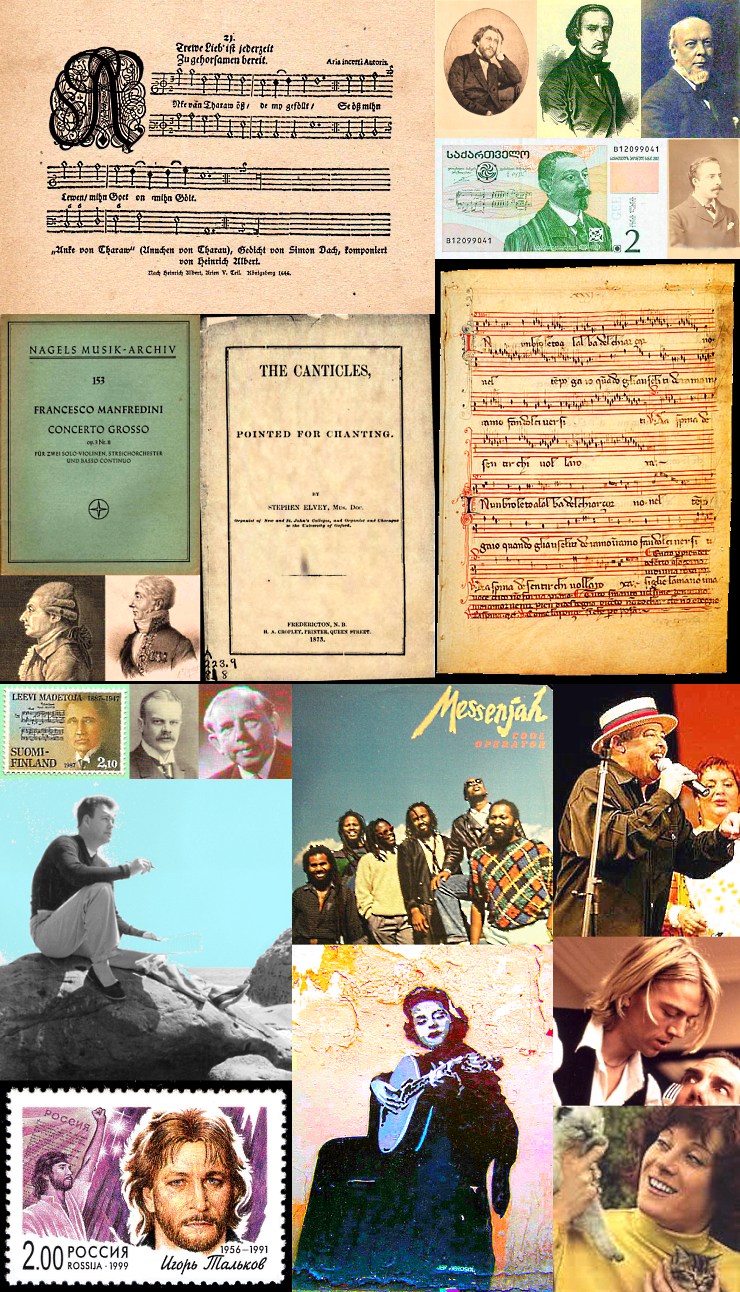
1651 – Heinrich Albert (German composer & poet)
1762 – Francesco Manfredini (Italian composer, violinist & church musician)
1786 – Antonio Sacchini (Italian opera composer)
1837 – Jean-François Le Sueur (French composer & conductor, teacher of Berlioz, Gounod & A. Thomas)
1860 – Stephen Elvey (English organist & composer)
1868 – Léon Kreutzer (French composer & pianist, nephew of Rodolphe)
1874 – Thomas Tellefsen (Norwegian pianist & composer)

1909 – Dudley Buck (American composer, organist, writer & teacher)
1933 – Zakaria Paliashvili [ზაქარია ფალიაშვილი
] (Georgian composer, conductor, hornist & folk song collector)
1935 – Sir Frederic Hymen Cowen (Jamaican-born English pianist, conductor & composer)
1940 – Ferdinando Liuzzi (Italian musicologist & composer, specialist in the Italian Trecento)
1947 – Leevi Madetoja (Finnish composer)
1954 – Hakon Børresen (Danish composer)

1973 – Arnold Walter (Czech-born Canadian musicologist, teacher, composer, pianist & writer)
1985 – Nelson Riddle (American arranger, composer, bandleader, orchestrator & trombonist)

1991 – Igor Talkov [И́горь Талько́в] (Russian rock singer, songwriter & guitarist )
1995 – Walter "Crash" Morgan (Canadian reggae & rock drummer, Messenjah, Big Sugar)
1999 – Amália Rodrigues (Portuguese fado singer, player of the Portuguese guitar & actress)

2004 – Marvin Santiago (Puerto Rican salsa singer & comedian)
2010 – Antonie Kamerling (Dutch actor & pop singer)

2010 – Colette Renard (French actress & pop singer)

They call Amália Rodrigues "Rainha do Fado" - the Queen of Fado, because it is she who did most to popularize this genre of music in the 20th century. And what is fado? It's a kind of Portuguese traditional music (one cannot call it "folk" music, because in some ways it is more a type of classical music) that originated almost 200 years ago, but has roots that go back much further. It is music with a solo singer, usually accompanied by the Portuguese guitar, an instrument very different from the usual guitar, with a rounded body and 12 strings, strung in double courses. There are two types of Portuguese guitar, as there are two types of fado - Lisboa and Coimbra, in both cases (I believe that's a Lisboa guitar Rodrigues is playing above).

As the guitars are shaped, tuned, and played in slightly different ways, likewise there are differences in the two types of fado. It is from Coimbra that fado gets its "academic" traditions, for Coimbra, in inland northwestern Portugal, has been a university town since the middle ages. Coimbra fado is usually performed only by men, who wear a particular kind of traditional black academic uniform, in a fairly formal setting. So, when you have a female singer of fado, like Amália Rodrigues, it's a pretty good bet you're listening to the Lisboa type! Also, in Coimbra fado, there is a peculiar way the audience has of expressing its approval - rather than applauding with the hands (which is what's done in Lisboa fado), they cough, or clear the throat. I'm all for this tradition being picked up by classical audiences, because it might cut down on all the coughing during the performances! And it is from Lisboa that fado gets its "marine" traditions, since Lisbon is of course on the coast, and has been an important port city since ancient times. The lyrics of fado traditionally deal with the life of the sea and sailors, and the life of the common poor people. But fado can have other kinds of lyrics, and it can also use many different kinds of instrumental accompaniment, such as a string quartet, or even a full orchestra.

Fado is a melancholy music. It is as hard to describe as it is to explain the Portuguese word with which it's most associated - saudade. Saudade is a word that can't be translated into any other language, at least not with a single word. It means the dreamlike feeling of longing one has for someone or something that has gone away, and left an emptiness that can't be filled by anyone or anything else. At the same time, it expresses the hope, often against all odds, that that for which one feels the saudades will return one day and make life whole again. Yet further, it expresses the fantasies about this fulfillment brought on by these hopeful feelings.

So you see, saudade is very hard to explain with the tongue, but very easy to understand with the heart. And it's the same with fado! So, let the beautiful music of Amália Rodrigues come into your ear and from there it will be transported to your heart, and you'll understand it all!

Be sure to follow the links in the list and read up on Nelson Riddle, one of the greatest arrangers in 20th-century music, who's most associated with the mid-career recordings of Frank Sinatra; and Igor Talkov, the Russian rock singer who took political risks in the Soviet era and became so beloved in his country; and Georgian composer Zakaria Paliashvili, who's considered to be the father of a truly national classical music in his home country.

Before I leave you, I'd like you to look at that page of 14th-century Italian black mensural notation that's on the right in the collage, and is in the spot where a photo of Ferdinando Liuzzi ought to be. Now, if you don't read music, that page might not be any more inscrutable than the page that's at the top left, from more than 300 years later, which is actually in modern notation, despite a few orthographic differences. If you do read music, the comparison will perhaps make you appreciate that reading music was a much more difficult task in the middle ages than it is today.

That page is from the Rossi Codex, once thought to be the earliest source of secular music from the Italian Trecento (that's the Italian term for the 14th century). When German scholars, such as Heinrich Besseler, first studied the Rossi in the 1920s, they assumed the manuscript was from Florence, like most of the surviving trecento sources. But a little later, Ferdinando Liuzzi, along with Ugo Sesini, and Ettore Li Gotti, having the advantage of being, you know, ITALIAN, noted that linguistic evidence in the texts points to the Veneto, in northern Italy, as its place of origin. Much later, in his publication of a facsimile of the Rossi Codex, Nino Pirrotta was to assert based on other evidence that the provenance of the manuscript could be narrowed down even further, to the city of Verona.

I did actually find a photo of Ferdinando Liuzzi. He's down there, along with ten other musicologists, at a conference in 1939, the year before he died of a heart attack. Liuzzi is the one standing just in front of the sconce (thanks, Mom!) on the right.

Standing L-R: Harold Spivacke, Otto Kinkeldey, Otto Gombosi, Knud Jeppesen, Fernando Liuzzi, Gustave Reese
Seated L-R: Edward J. Dent, Carleton Sprague Smith, Curt Sachs, Alfred Einstein, Dayton C. Miller

The names in the caption probably won't mean anything to you, unless you're someone like me who attempted a professional degree in historical musicology. To me, most of them are legendary figures. Well, anyway... this has been your music theory jock/musicology geek moment for the week...