Showing posts with label Nelson Riddle. Show all posts

01-21: Peggy Lee & Nelson Riddle : Jump For Joy 1958 - Best Of Charles Brown 1945-1956 - Champion Jack Dupree : Blues for Everyone 1969 - Wolf-Ferrari Violin Concerto | Serenade for Strings / Hoelscher | Francis 1994

Not shown: Domenico Mazzocchi, John Vincent, John Gibbs & Peter Stadlen
1638 – Ignazio Donati (Italian composer)
1665 – Domenico Mazzocchi (Italian composer)
1851 – Albert Lortzing (German composer, actor & singer)
1876 – Therese [Müller] Grünbaum (Austrian soprano, creator of Eglantine in Weber’s Euryanthe)
1882 – Anton Emil Titl (Austrian composer & conductor)
1883 – Jacopo Tomadini (Italian priest, composer & organist)
1884 – Auguste Franchomme (French cellist & composer, friend of Mendelssohn & dedicatee of Chopin's Cello Sonata, Op. 65)
1888 – Stephan Hale Alonzo Marsh (English-born Australian composer & harpist, active also in the United States & Japan)
1891 – Calixa Lavallée (Canadian composer, pianist & teacher, active also in the United States, "O Canada")
1894 – Guillaume Lekeu (Belgian composer, pupil of Franck & D'Indy)
1931 – Felix Blumenfeld [Фе́ликс Блуменфе́льд] (Russian composer, conductor & pianist, pupil of Rimsky-Korsakov, teacher of Horowitz)
1942 – Henryk Opieński (Polish composer, violinist, teacher & musicologist, early Chopin scholar & friend of Paderewski)
1948 – Ermanno Wolf-Ferrari (Italian composer, conductor & teacher)
1959 – Lamar Stringfield (American composer, flutist, conductor & anthologist of American folk songs)
1961 – John Joseph Becker (American composer, one of the American Five)
1977 – John Vincent (American composer, conductor, teacher & author)
1977 – Zoltán Vásárhelyi (Hungarian choral conductor, composer, violinist & teacher)
1984 – Jackie Wilson (American R&B singer & songwriter, "Mr. Excitement", Billy Ward and His Dominoes)
1985 – Barbara Cowsill (American pop singer, The Cowsills)
1989 – Billy [Dorothy Lucille] Tipton (American jazz pianist, saxophonist & bandleader)
1992 – Champion Jack Dupree (American blues pianist & boxer)
1996 – John Gibbs (English baritone)
1996 – Peter Stadlen (Austrian-born British composer, pianist & musicologist, specialist in Beethoven)
1997 – Colonel Tom Parker [Andreas Cornelis van Kuijk] (Dutch-born American impresario, manager of Elvis Presley)
1999 – Charles Brown (American blues singer & pianist)
2002 – Peggy Lee [Norma Deloris Egstrom] (American jazz & pop singer, songwriter, composer & actress)
2007 – U;Nee [Heo Yoon] (Korean pop singer, rapper, dancer & actress)
2010 – Paul Quarrington (Canadian novelist, playwright, screenwriter, filmmaker, musician & teacher)


Billy Tipton was a female pianist who began dressing as a man in the 1930s so it would be easier for her to find work playing in jazz clubs. But even long after the jazz world had become more receptive to female instrumentalists, she continued to dress and self-identify as a man. Billy Tipton was in fact a lesbian. And unbelievably enough, she somehow managed over the course of her life to fool five husbands, and several government agencies, into believing she was a man. It was only upon her death that the truth about her gender was revealed. One of the most astonishing stories in jazz history.

11-11: Rev. Gary Davis Harlem Street Singer 1960 - Allman Brothers Idlewild South 1970 - Schoenberg Piano Music Steuermann 1957 - Ella Fitzgerald Jerome Kern Songbook 1963


1895 – Julius Tausch (German pianist, composer & conductor)
1901 – Antonio Zamara (Italian harpist & composer, active in Vienna)
1912 – Józef Wieniawski (Polish pianist, composer & conductor, younger brother of Henryk)
1929 – Mieczysław Soltys (Polish composer)
1936 – Edward German (English theatrical composer of Welsh descent)
1945 – Jerome Kern (American musical theater composer)
1964 – Edward Steuermann (Austrian-born American pianist & composer)
1967 – Harry Seymour (American actor & soundtrack composer)
1968 – Jeanne Demessieux (French organist, pianist, composer & teacher)
1972 – Berry Oakley (American rock bass guitarist, Allman Brothers Band)
1974 – Alfonso Leng (Chilean composer & dentist)
1977 – Greta Keller (Austrian cabaret singer & actress)
1979 – Dimitri Tiomkin [Дмитро Тьомкін] (Ukrainian-born American film composer, conductor & pianist)
1988 – William Ifor Jones (Welsh conductor & organist)
1993 – Erskine Hawkins (American jazz trumpeter & big band leader)
1994 – Dame Elizabeth Maconchy (English composer)
1995 – Kenneth S. Goldstein (American folklorist, record producer, ethnomusicologist & teacher)


10-06: Amália Rodrigues Best of Fado - И́горь Талько́в Grand Collection - Rosemary Clooney Solves the Swingin' Riddle 1961 - Véronique Gens / Christophe Rousset : Tragédiennes 2


1651 – Heinrich Albert (German composer & poet)
1762 – Francesco Manfredini (Italian composer, violinist & church musician)
1786 – Antonio Sacchini (Italian opera composer)
1837 – Jean-François Le Sueur (French composer & conductor, teacher of Berlioz, Gounod & A. Thomas)
1860 – Stephen Elvey (English organist & composer)
1868 – Léon Kreutzer (French composer & pianist, nephew of Rodolphe)
1874 – Thomas Tellefsen (Norwegian pianist & composer)

1909 – Dudley Buck (American composer, organist, writer & teacher)
1933 – Zakaria Paliashvili [ზაქარია ფალიაშვილი
] (Georgian composer, conductor, hornist & folk song collector)
1935 – Sir Frederic Hymen Cowen (Jamaican-born English pianist, conductor & composer)
1940 – Ferdinando Liuzzi (Italian musicologist & composer, specialist in the Italian Trecento)
1947 – Leevi Madetoja (Finnish composer)
1954 – Hakon Børresen (Danish composer)

1973 – Arnold Walter (Czech-born Canadian musicologist, teacher, composer, pianist & writer)
1985 – Nelson Riddle (American arranger, composer, bandleader, orchestrator & trombonist)

1991 – Igor Talkov [И́горь Талько́в] (Russian rock singer, songwriter & guitarist )
1995 – Walter "Crash" Morgan (Canadian reggae & rock drummer, Messenjah, Big Sugar)
1999 – Amália Rodrigues (Portuguese fado singer, player of the Portuguese guitar & actress)

2004 – Marvin Santiago (Puerto Rican salsa singer & comedian)
2010 – Antonie Kamerling (Dutch actor & pop singer)

2010 – Colette Renard (French actress & pop singer)

They call Amália Rodrigues "Rainha do Fado" - the Queen of Fado, because it is she who did most to popularize this genre of music in the 20th century. And what is fado? It's a kind of Portuguese traditional music (one cannot call it "folk" music, because in some ways it is more a type of classical music) that originated almost 200 years ago, but has roots that go back much further. It is music with a solo singer, usually accompanied by the Portuguese guitar, an instrument very different from the usual guitar, with a rounded body and 12 strings, strung in double courses. There are two types of Portuguese guitar, as there are two types of fado - Lisboa and Coimbra, in both cases (I believe that's a Lisboa guitar Rodrigues is playing above).

As the guitars are shaped, tuned, and played in slightly different ways, likewise there are differences in the two types of fado. It is from Coimbra that fado gets its "academic" traditions, for Coimbra, in inland northwestern Portugal, has been a university town since the middle ages. Coimbra fado is usually performed only by men, who wear a particular kind of traditional black academic uniform, in a fairly formal setting. So, when you have a female singer of fado, like Amália Rodrigues, it's a pretty good bet you're listening to the Lisboa type! Also, in Coimbra fado, there is a peculiar way the audience has of expressing its approval - rather than applauding with the hands (which is what's done in Lisboa fado), they cough, or clear the throat. I'm all for this tradition being picked up by classical audiences, because it might cut down on all the coughing during the performances! And it is from Lisboa that fado gets its "marine" traditions, since Lisbon is of course on the coast, and has been an important port city since ancient times. The lyrics of fado traditionally deal with the life of the sea and sailors, and the life of the common poor people. But fado can have other kinds of lyrics, and it can also use many different kinds of instrumental accompaniment, such as a string quartet, or even a full orchestra.

Fado is a melancholy music. It is as hard to describe as it is to explain the Portuguese word with which it's most associated - saudade. Saudade is a word that can't be translated into any other language, at least not with a single word. It means the dreamlike feeling of longing one has for someone or something that has gone away, and left an emptiness that can't be filled by anyone or anything else. At the same time, it expresses the hope, often against all odds, that that for which one feels the saudades will return one day and make life whole again. Yet further, it expresses the fantasies about this fulfillment brought on by these hopeful feelings.

So you see, saudade is very hard to explain with the tongue, but very easy to understand with the heart. And it's the same with fado! So, let the beautiful music of Amália Rodrigues come into your ear and from there it will be transported to your heart, and you'll understand it all!

Be sure to follow the links in the list and read up on Nelson Riddle, one of the greatest arrangers in 20th-century music, who's most associated with the mid-career recordings of Frank Sinatra; and Igor Talkov, the Russian rock singer who took political risks in the Soviet era and became so beloved in his country; and Georgian composer Zakaria Paliashvili, who's considered to be the father of a truly national classical music in his home country.

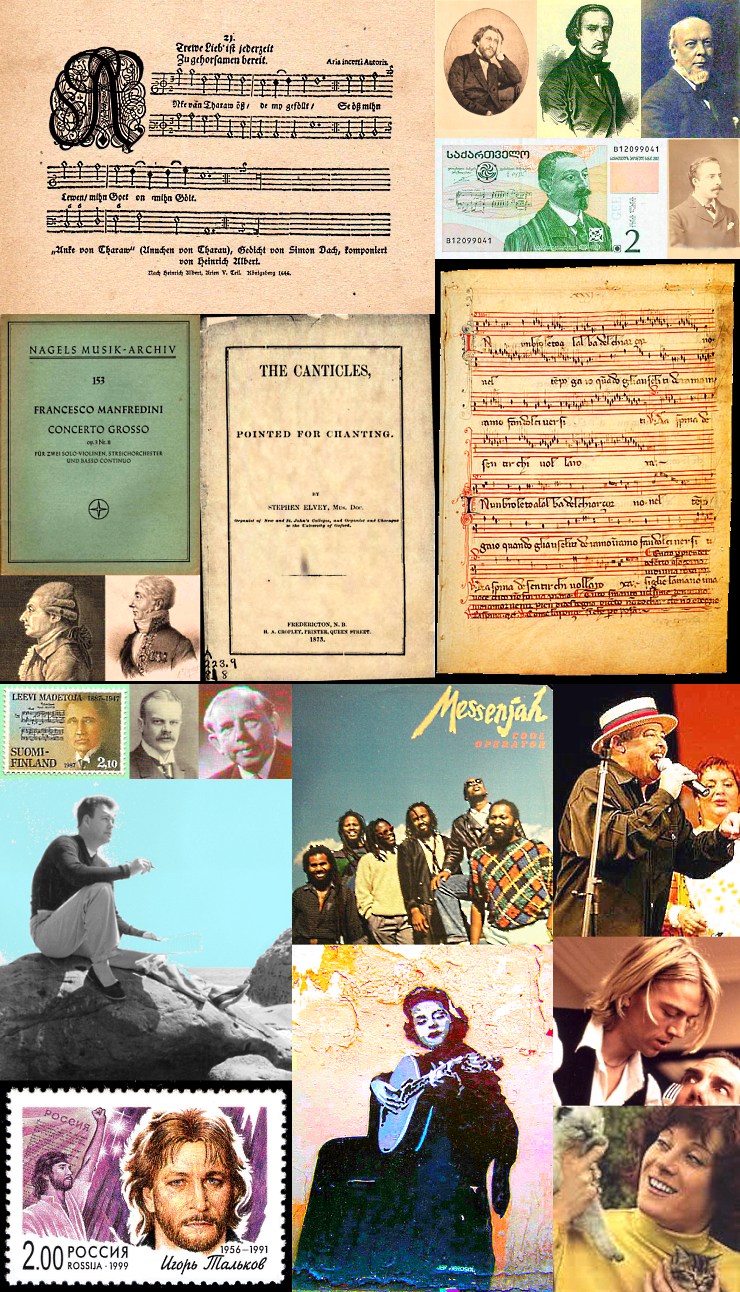
Before I leave you, I'd like you to look at that page of 14th-century Italian black mensural notation that's on the right in the collage, and is in the spot where a photo of Ferdinando Liuzzi ought to be. Now, if you don't read music, that page might not be any more inscrutable than the page that's at the top left, from more than 300 years later, which is actually in modern notation, despite a few orthographic differences. If you do read music, the comparison will perhaps make you appreciate that reading music was a much more difficult task in the middle ages than it is today.

That page is from the Rossi Codex, once thought to be the earliest source of secular music from the Italian Trecento (that's the Italian term for the 14th century). When German scholars, such as Heinrich Besseler, first studied the Rossi in the 1920s, they assumed the manuscript was from Florence, like most of the surviving trecento sources. But a little later, Ferdinando Liuzzi, along with Ugo Sesini, and Ettore Li Gotti, having the advantage of being, you know, ITALIAN, noted that linguistic evidence in the texts points to the Veneto, in northern Italy, as its place of origin. Much later, in his publication of a facsimile of the Rossi Codex, Nino Pirrotta was to assert based on other evidence that the provenance of the manuscript could be narrowed down even further, to the city of Verona.

I did actually find a photo of Ferdinando Liuzzi. He's down there, along with ten other musicologists, at a conference in 1939, the year before he died of a heart attack. Liuzzi is the one standing just in front of the sconce (thanks, Mom!) on the right.

Standing L-R: Harold Spivacke, Otto Kinkeldey, Otto Gombosi, Knud Jeppesen, Fernando Liuzzi, Gustave Reese
Seated L-R: Edward J. Dent, Carleton Sprague Smith, Curt Sachs, Alfred Einstein, Dayton C. Miller

The names in the caption probably won't mean anything to you, unless you're someone like me who attempted a professional degree in historical musicology. To me, most of them are legendary figures. Well, anyway... this has been your music theory jock/musicology geek moment for the week...